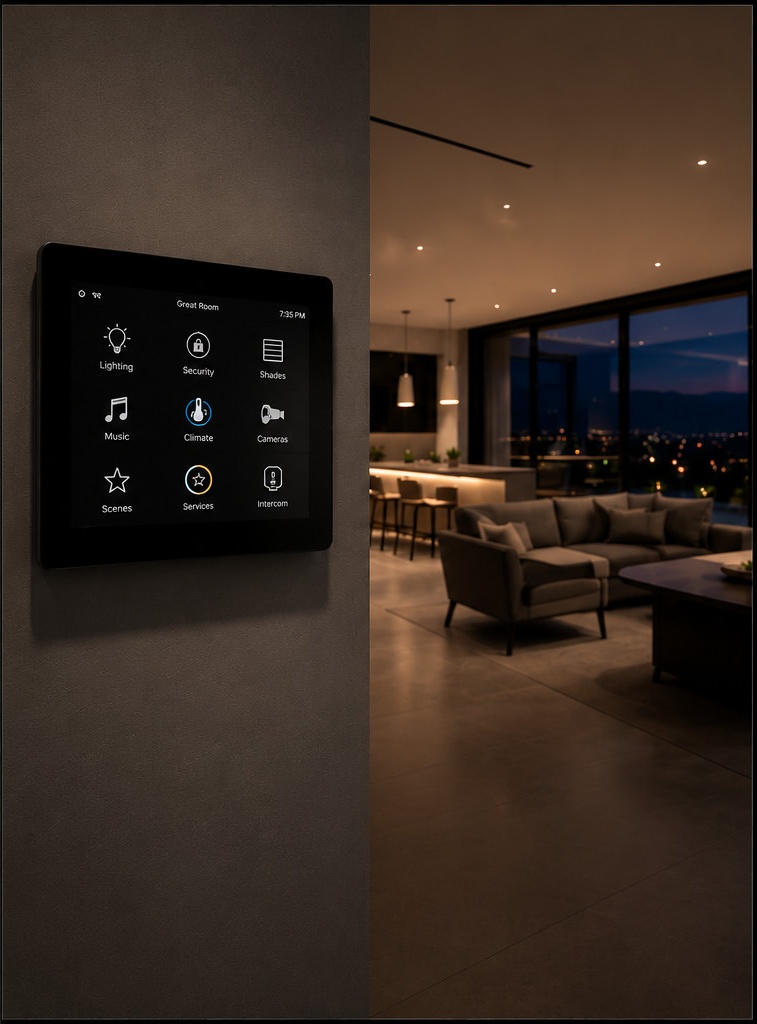
The Evening Scene™
The Motorized Shades Guide.
Light, privacy, and view — controlled at the touch of a button or on a schedule you never have to think about. Here is how motorized shades actually work in a luxury home.
The Foundation
Why Choose Motorized Shades.
Manual shades work fine on one window. On a house with forty of them, at varying heights, behind furniture and above staircases, they stop being practical. Motorized shades solve a real problem — and they do far more than raise and lower fabric.
- Effortless Daily Use — one press, one voice command, or one scheduled event moves every shade in a room, a wing, or the entire house together.
- Protection For What You Own — art, rugs, hardwood, and furnishings fade under UV exposure. Shades that adjust automatically through the day limit that damage without anyone remembering to close a blind.
- Access Where You Need It Most — skylights, transoms, and oversized great-room glass are difficult or impossible to reach by hand. Motorization makes every opening usable.
- Quiet Technology™ — the motors and tracks we specify are engineered to be silent and reliable for decades, not a novelty that grinds and jams within a year.
- Built Into The Architecture — recessed pockets, concealed wiring, and hidden hardware keep the shading system out of sight until it moves. That is our Invisible Technology™ philosophy applied to window treatments.
The Everyday Workhorse
Roller Shades.
Roller shades are the most common motorized window treatment in luxury homes, and for good reason. They are clean, low-profile, and available in a nearly unlimited range of fabrics and openness levels.
- Single Roller Applications — a light-filtering or solar fabric on one roller, ideal for bedrooms, offices, and rooms where full blackout is not the priority.
- Dual Roller Systems — a sheer or solar fabric paired with a blackout fabric on the same window, controlled independently or together, giving one opening two completely different moods.
- Recessed Pocket Installations — the roller and its hardware disappear into a ceiling or window-head pocket built during construction, leaving only fabric visible when lowered.
- Fabric & Fascia Options — hundreds of weaves, textures, and colors, with cassette or open-roller fascia choices to match trim and millwork.
- Lutron Shades — ACT Installs is a Lutron dealer, and roller shades are where Lutron's shading line performs best: quiet motors, precise stop positions, and tight integration with lighting and scheduling.
Total Darkness, On Command
Blackout Shades.
True blackout is harder to achieve than most homeowners expect. It requires side channels or close-tolerance track systems that seal light from creeping around the edges of the fabric, not just a dark-colored roller shade.
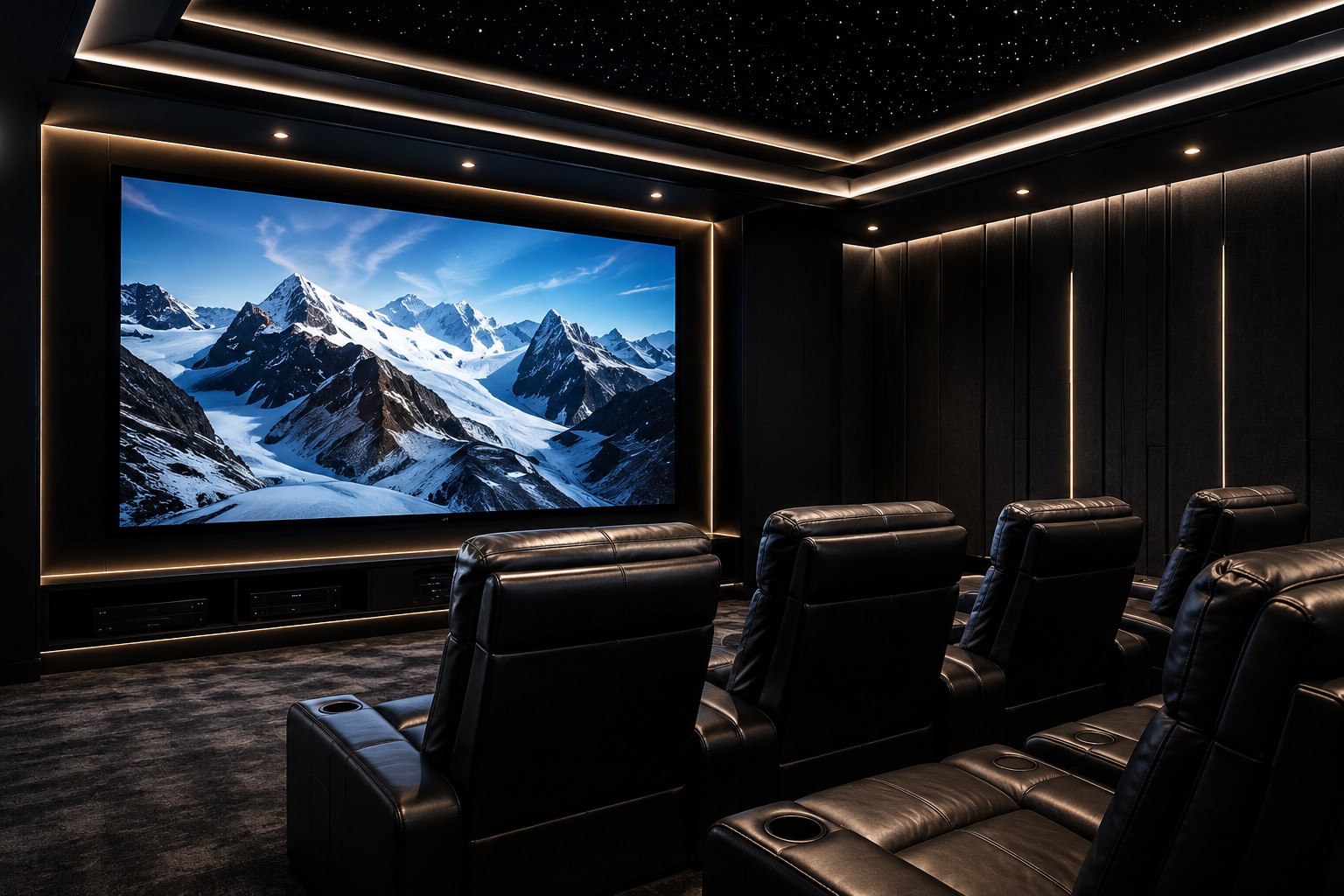
- Home Theater Rooms — every ACT Cinema™ installation with any ambient light source is paired with true blackout shades, because contrast and image quality collapse the moment daylight enters the room.
- Primary Bedrooms — a full blackout scene, dropped automatically at bedtime as part of a One Touch Living™ command, changes sleep quality more than almost any other technology upgrade in the house.
- Layered With Sheers — blackout fabric on a dual-roller system behind a sheer or solar shade gives a room both softness during the day and complete darkness at night, from the same window.
- Side-Channel Systems — for rooms where light leakage cannot be tolerated at all, we specify tracked blackout shades with side channels that seal the full perimeter of the window.
View Without the Glare
Solar Shades.
Coastal California homes are built around glass — ocean views, courtyards, mountain sightlines. Solar shades let you keep the view while controlling the heat and glare that come with it.
- Openness Factor — fabrics are rated by how much light and view pass through, from nearly sheer to nearly opaque, letting each room be tuned to its own sun exposure.
- UV & Heat Rejection — solar fabrics block a significant share of ultraviolet transmission and reduce solar heat gain, keeping rooms with large glass more comfortable without closing off the view.
- Ideal For Great Rooms & Glass Walls — floor-to-ceiling glass and disappearing wall systems are common in this region's newer construction, and solar shades are usually the right treatment for them.
- Color & Weave Choice — darker weaves preserve outward view at the cost of some privacy at night; lighter weaves do the opposite. We walk through this trade-off room by room.
Fabric, Motorized
Drapery Systems.
Motorized drapery brings the softness and formality of traditional fabric to spaces where a roller shade would feel too casual — formal living rooms, dining rooms, and primary suites.
- Motorized Traverse Tracks — quiet, silent-glide tracks move drapery panels along a curved or straight path, sized to the exact window and ceiling height.
- Ripple Fold & Pleated Styles — the track system determines how the fabric hangs when open and closed, from a tailored ripple fold to a traditional pleated drape.
- Layered With Shades — drapery is frequently specified alongside a roller or solar shade on the same window, with drapery providing texture and formality and the shade doing the daily light work.
- Best For Statement Rooms — two-story windows, formal entries, and primary bedrooms are where motorized drapery earns its place in a design.
Set It Once
Smart Scheduling.
The real value of motorized shades shows up when nobody has to press a button at all. A properly programmed system adjusts itself throughout the day based on the sun, the season, and the room.
- Astronomic Timeclock — schedules reference actual sunrise and sunset for your exact location, shifting automatically through the seasons instead of running on a fixed clock time.
- Room-By-Room Logic — an east-facing kitchen and a west-facing media room need opposite schedules. Each room's shades are programmed to its own sun exposure.
- Weather & Sun-Angle Response — solar shades on exposed glass can be set to lower automatically as direct sun crosses a window, then retract once the angle passes.
- Lutron Shades Scheduling — Lutron's control platform is built specifically for this kind of astronomic and room-based scheduling, which is a major reason we specify it for whole-home shading.
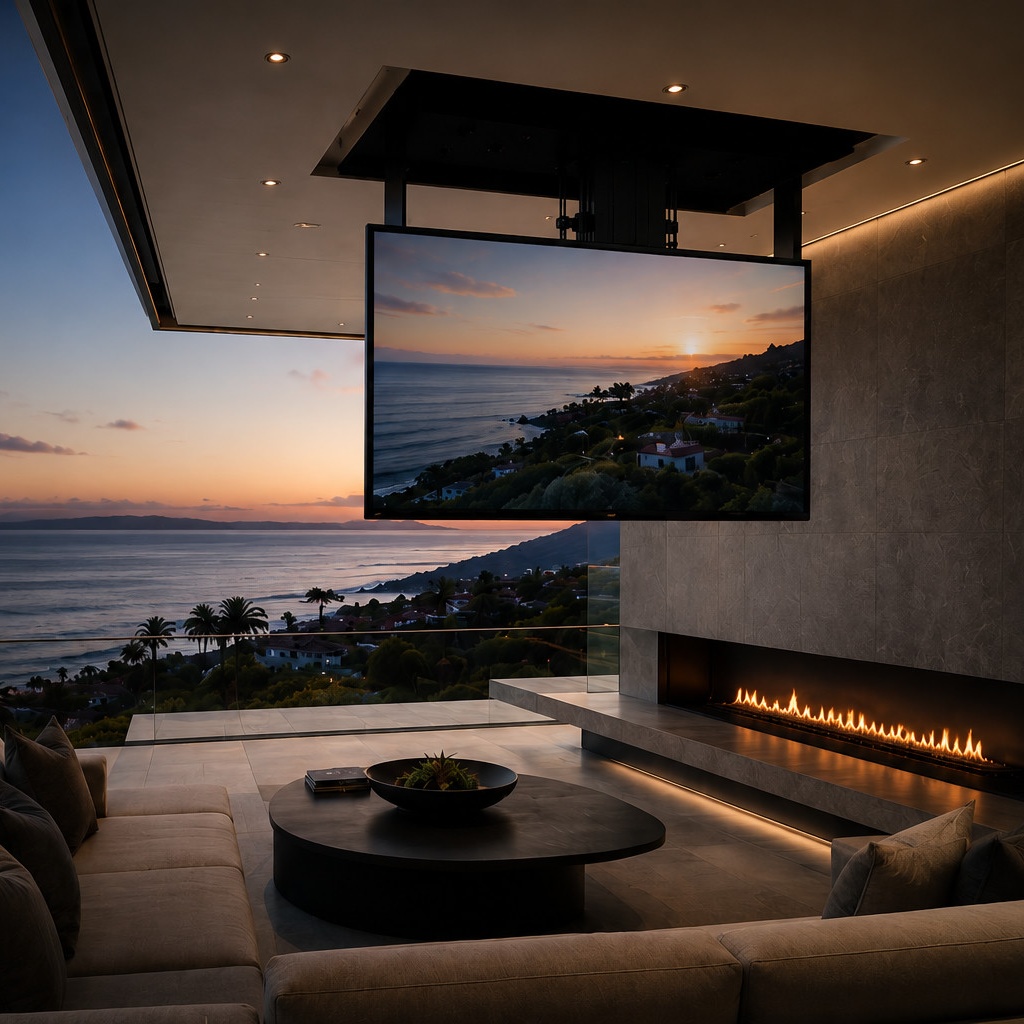
The Evening Scene™
Lighting & Scene Integration.
Shades are rarely programmed on their own in an ACT Estate™ home. They move as part of a scene, alongside lighting, audio, and climate, so the whole room shifts mood at once.
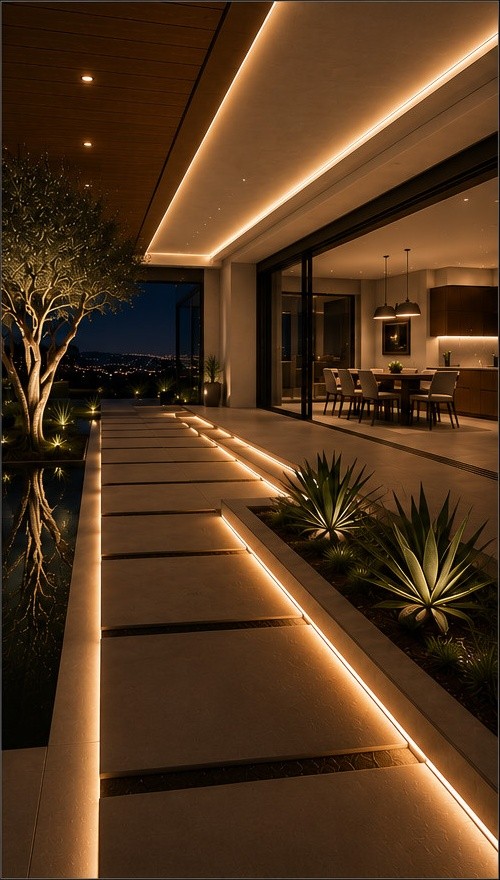
- The Evening Scene™ — as daylight fades, shades lower and interior lighting warms and dims in tandem, on a timeline tuned to how the house is actually used at that hour.
- One Touch Living™ — a single command for "movie night," "dinner," or "goodnight" lowers the correct shades along with everything else in the scene, no separate remote required.
- The Arrival Experience™ — shades can be part of the sequence that greets you at the gate, opening the entry and key living spaces to daylight as you pull in.
- Consistent Across Rooms — because shades, lighting, and audio are on one platform, scenes behave the same way in every room of the house, not room by room with different remotes.
Comfort & Cost
Energy Efficiency.
Window treatments are one of the more overlooked levers in a home's energy profile. Automated shading does automatically what a homeowner would rarely do consistently by hand.
- Reduced Solar Heat Gain — shades that close automatically during peak sun exposure keep rooms cooler and take real load off the HVAC system during summer afternoons.
- Winter Insulation — closing shades at night adds a layer of insulation against glass, one of the least efficient surfaces in any home, reducing heat loss.
- Automatic, Not Optional — the efficiency benefit only materializes if the shades actually move on schedule. Automation removes the human inconsistency that undermines manual shading.
- Works With The Rest Of The Home — shading schedules can be coordinated with HVAC and lighting automation for a more complete energy strategy, not a standalone fix.
Discretion, Automated
Privacy & Security.
Shades do quiet security work that has nothing to do with cameras or alarms. A house that looks lived-in, and windows that close on schedule, are both meaningful deterrents.
- Privacy Scheduling — street-facing windows can be set to close at dusk automatically, without anyone needing to remember, so interior rooms are never lit and exposed after dark.
- The Vacation Mode™ — while you are away, shades cycle on a believable schedule alongside lighting, making the house look occupied rather than sitting shuttered or, worse, wide open.
- Ground-Floor & Guest Areas — rooms with the most street or neighbor visibility are usually the highest priority for automated privacy scheduling.
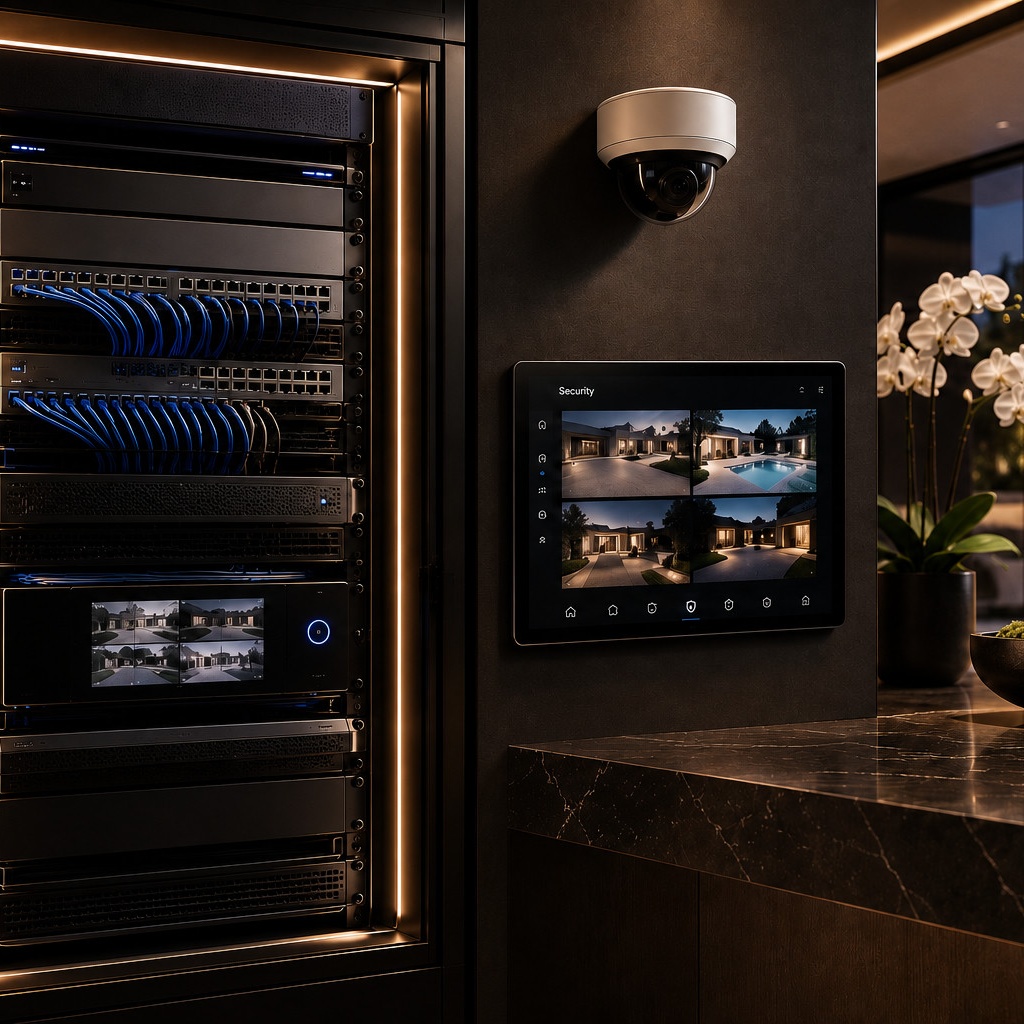
- Paired With The Estate Network™ — because shading runs on the same reliable network backbone as security and access, schedules and remote commands stay dependable.
Getting It Right
Installation Planning.
Motorized shades are far easier and cleaner to install before drywall goes up than after. Planning ahead determines whether the hardware disappears or becomes something you look at every day.
- Pocket & Valance Details — recessed pockets need to be framed into the window head during construction. Retrofitting them later usually means visible surface-mounted hardware instead.
- Low-Voltage Wiring — even battery and rechargeable shade motors benefit from planned wire paths for charging and hard-wired control, run before walls close.
- New Construction & The Builder Ready Program™ — on new builds, we coordinate directly with architects and builders early, so shade pockets, wiring, and window rough openings are correct the first time.
- Retrofit Homes — existing homes are not excluded. Surface-mounted and cassette-style shades install cleanly without construction, with a small trade-off in how concealed the hardware is.
- Window Measurement Precision — motorized shades are built to exact window dimensions. Field verification before ordering avoids the delays that come with a fabricated shade that does not fit.
ACT Tip
If you are still in design or early framing, this is the ideal time to talk with a Luxury Technology Advisor. Schedule a consultation before pockets and wiring are locked into the plans.
Investment Levels
Budget Guide.
Shading budgets vary widely based on window count, fabric selection, motorization type, and how deeply the system integrates with lighting and whole-home automation. These three tiers describe general scope, not fixed pricing.
Tier 01Foundational
Motorized roller or solar shades on primary living spaces, with app and remote control and basic scheduling. A strong starting point for daily convenience and light control.
Tier 02Elevated
Whole-home shading across most or all windows, dual-roller and blackout combinations where needed, astronomic scheduling, and integration with lighting scenes like The Evening Scene™.
Tier 03Signature
Full-estate coverage including motorized drapery, custom fabrications for oversized and specialty glass, and complete integration into One Touch Living™ and Vacation Mode™ scenes.
ACT Tip
Every home's window count, fabric choices, and integration goals are different, so we do not quote pricing in the abstract. Schedule a consultation for an accurate proposal, or explore a related space with the ACT Theater Builder™ if blackout shading for a media room is part of the plan.