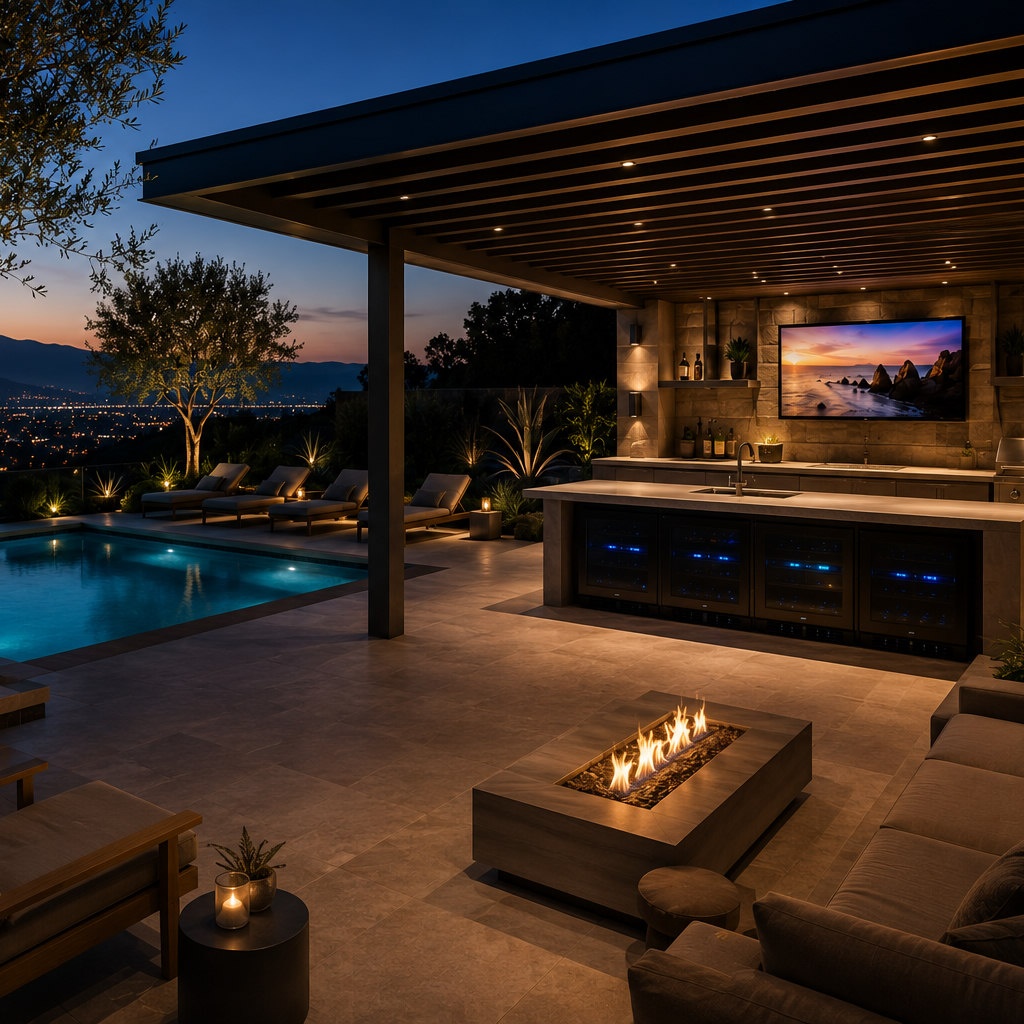
The cheapest way to get a screen on a patio is to carry out an indoor television and mount it under an overhang. It's also, almost always, the most expensive mistake — because an indoor panel is not built to survive outdoor life, and the failure usually shows up right when you'd want the TV most.
A true outdoor-rated television is a different product from the inside out: sealed housing, anti-glare high-brightness glass, and an operating range built for heat, humidity, and temperature swings an indoor panel was never engineered to handle.
Indoor panels use standard LCD glass optimized for a dim room, sealed only well enough to keep out household dust. Direct sun makes the screen unreadable long before it damages anything; humidity and temperature swings are what actually kill it — condensation forming inside the panel, backlight failure from heat, and seal degradation that lets moisture in over a season or two.
Outdoor-rated panels solve all three at the component level: sealed, weatherproof housings, anti-reflective high-brightness glass built to stay readable in direct daylight, and an operating temperature range that covers real outdoor swings rather than a climate-controlled room.
| Criteria | Outdoor-Rated TV | Indoor TV Outside |
|---|---|---|
| Weatherproofing | Sealed housing, rated for humidity & rain exposure | None — dust seals only |
| Brightness | 1,500–2,500+ nits, readable in direct sun | 300–500 nits, washes out outdoors |
| Temperature range | Engineered for heat, cold, and swings | Narrow indoor comfort range |
| Typical lifespan outdoors | 5–10+ years as designed | Months to 1–2 years before failure |
| Upfront cost | Higher | Lower, but a false economy |
| Best for | Covered or fully exposed patios, pool decks | Nowhere, long-term |
We don't install indoor televisions outdoors, even under generous cover — it's a callback waiting to happen, usually within a single hot summer. An outdoor-rated panel, sized correctly for the space's sun exposure, is the only version of this we stand behind.
We don't recommend it. Humidity and heat, not just rain, are what damage indoor panels outdoors — condensation and backlight failure happen even under full cover.
It depends on sun exposure — a fully exposed pool deck typically needs 1,500–2,500+ nits to stay readable in daylight, while a shaded or covered space can use a lower-brightness outdoor-rated model.
True outdoor-rated panels are weatherproof on their own, without an added enclosure. Some fully exposed or extreme-climate installations still pair one with a protective cover for storm season or off-hours protection.
Well-specified outdoor televisions are built for a 5-10+ year lifespan in real outdoor conditions, versus months for an indoor panel exposed to the same environment.
See the full Outdoor Living service, or talk to a Luxury Technology Advisor about the right screen for your patio's sun exposure.
Explore Outdoor Living