Consumer mesh systems — the kind sold in a two- or three-pack at retail — are genuinely good for a typical home: easy setup, decent coverage, one app. Enterprise-grade WiFi, the access-point-and-controller architecture used in offices, hotels, and the estates we build, solves a different problem: dozens of simultaneous devices, structured wiring instead of wireless daisy-chaining between nodes, and centralized management that a consumer mesh app was never designed to offer.
| Criteria | Consumer Mesh | Enterprise WiFi (UniFi-class) |
|---|---|---|
| Architecture | Wireless nodes, often daisy-chained | Wired access points, PoE, structured |
| Device capacity | Dozens of devices comfortably | Hundreds of devices per access point |
| Management | Single consumer app | Centralized controller, per-AP tuning |
| Backhaul | Often wireless between nodes | Dedicated wired backhaul to each AP |
| Install complexity | Plug-and-play, self-installed | Professionally designed & cabled |
| Best for | Apartments, smaller homes | Large estates, multi-building properties |
A consumer mesh system's nodes usually talk to each other wirelessly, which means every "hop" between nodes eats into the bandwidth available to your devices. On a large property with a pool house, a detached garage, or multiple floors, that wireless backhaul is often the actual bottleneck — not the internet connection itself.
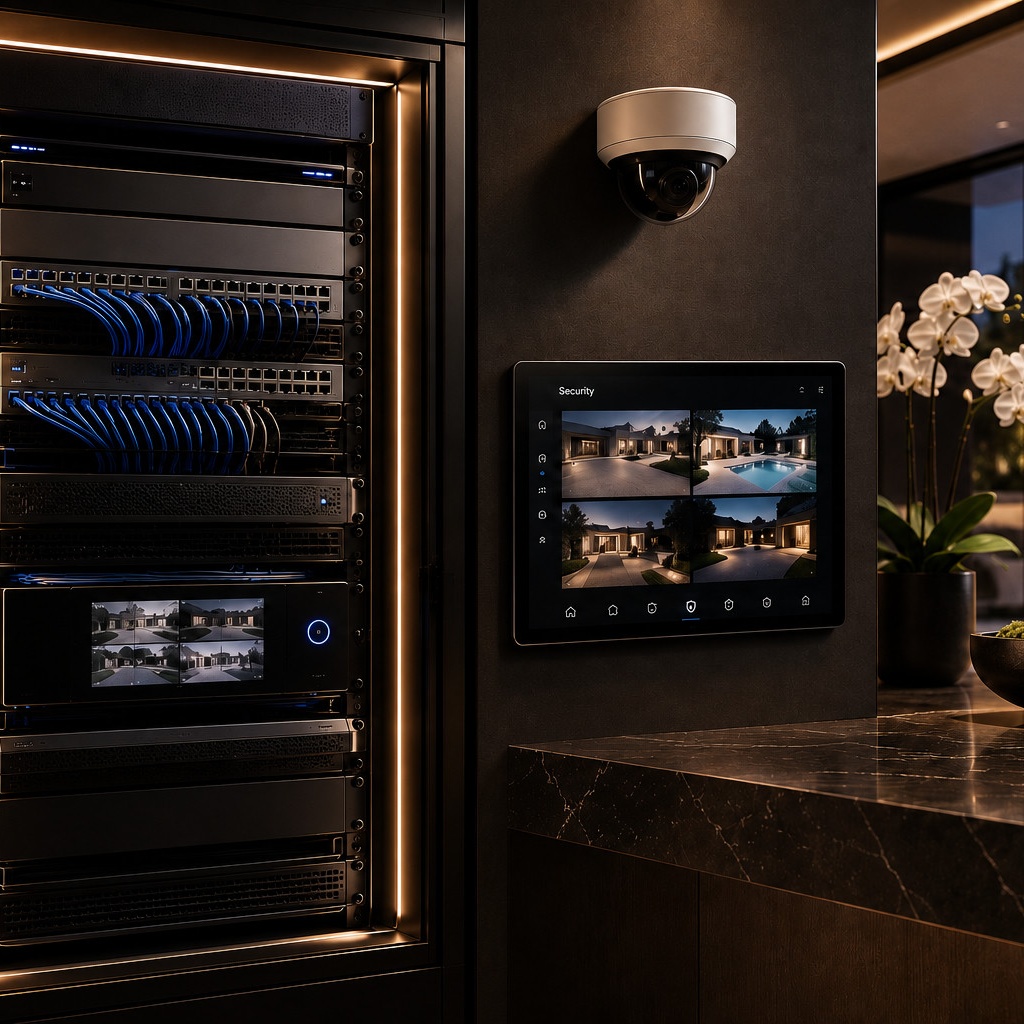
Enterprise-grade access points run on dedicated wired backhaul to a central switch, so every access point delivers full performance regardless of how many others are active. It's the same reason hotels and offices don't run on consumer mesh kits — the architecture is built for scale from the start.
For anything larger than a typical single-family home — a multi-structure estate, a property with a guest house or pool pavilion, or a home with real device density — we design and install enterprise-grade access points on wired backhaul rather than a consumer mesh kit, even though the individual access points look similar on a shelf.
It helps, but consumer mesh nodes are still limited by wireless backhaul and per-app management — fine for a typical home, but it doesn't scale cleanly to an estate with dozens of connected devices and multiple structures.
Not necessarily — a well-placed consumer mesh system serves a typical single-family home well. Enterprise-grade access points earn their cost in larger, more device-dense, or multi-structure properties.
Some access points support wireless mesh as a fallback, but you lose the core advantage — dedicated wired backhaul — that makes enterprise WiFi outperform consumer mesh in the first place.
The hardware itself is often comparably priced per access point, but enterprise systems typically involve professional design, cabling, and configuration — which is where most of the added cost and value comes from.
See the full Security & Networking service, or talk to a Luxury Technology Advisor about whole-property WiFi design.
Explore Security & Networking